
The research is in! If you’ve ever wondered if there’s a true, evidence-based connection between handwriting and learning, the results may surprise you. In this post, we’ll delve into the science of handwriting and comprehension, and explore why putting pen to paper can actually help your brain learn more effectively.
Home » TeacherWriter.co Blog and News » Teaching Writing »
I don’t know about you, but I’m a note taker by nature. When I was learning Spanish, I spent many years taking notes on a laptop. I had a few professors that discouraged me from taking notes at all. They said they would provide a summary of the lesson notes that I could use to review.
So imagine my surprise, having always been a good student, when I just couldn’t seem to get past the basic intermediate level in Spanish. When I spoke to people, they could barely understand me.
Until I made one small, but incredibly important change.
I began taking notes by hand. I wrote in cursive mostly, but printed the BIG IDEAS in all caps. I added some colorful underlining. I started a new page for each lesson.
Within weeks, (yes, literally just a few weeks), my ability to converse, write, and read in Spanish skyrocketed.
I began to wonder about our students in our classes. Should we be requiring them to take notes by hand? Here’s what the research reveals.

This post was first published on October 6, 2025. It was most recently updated on April 10, 2026.
Some of the links in this post are for affiliate offers. This means that if you make a purchase, TeacherWriter LLC may receive a small commission at no extra cost to you. Learn more on our Privacy Policy and Legal Disclosures page.
Summary of Key Points About Handwriting and Learning Retention
Recent research shows that handwriting activates more areas of the brain and strengthens learning retention better than typing. When students take notes by hand, they slow down, think critically about what matters, and organize information in ways that deepen comprehension. One study showed up to a 20% boost in understanding for handwritten notes compared to typed ones. The process of handwriting turns on metacognition—thinking about one’s own learning—making it an effective, evidence-based teaching strategy for lasting understanding.
Is there a link between handwriting and learning?
Certainly it’s faster to take notes on a computer. You can make notes of practically everything in a lecture or lesson. But what’s actually happening? Are you truly learning, or just transcribing?
Unfortunately, when typing notes on a keyboard or tablet, it’s easy to become a human transcription machine. Sure, you can read and review the notes later, but will the learning actually stick?
What the science of handwriting shows
Some research has shown that when writing notes about a lesson by hand, it forces you to do some things that don’t happen when you type.
- You’re forced to slow down. I don’t know of anyone who can write by hand as fast as a teacher, professor, or lecturer can talk. Do you?
- When you slow down, by default, you have to stop and think. What are the key points? The nuggets of wisdom? Which are the essential ideas? These are the points you’ll be able to write by hand. This selection and summarizing is powerful. It forces you to think about what you’re learning and is a prime example of metacognition, a way to strengthen comprehension and boost retention.
- When you write those key notes, you also have to decide how you want to organize those handwritten notes. Will you use Cornell notes, mind maps, fishbone notes, sketchy doodle notes? In elementary and middle school classes, the teacher can provide the note-taking structure on a worksheet and have the students fill it in.
- Speaking of sketch notes, one reason they’re so popular with teachers is because they can see the increase in recall and comprehension when their students use them. In fact, in this short Youtube video, Makai Allbert, Handwriting Literally Rewires Your Brain, he mentions a 2014 study by Mueller and Oppenheimer in which researchers noted a 20% increase in comprehension.
- Even when students are allowed to review their notes before an exam or test, the ones who hand wrote their class notes fared better than the ones who had longer notes done on a computer.

Handwriting and comprehension and memory recall
Much of the research points to very little difference in recall of basic facts or vocabulary between taking computer notes and handwriting notes. But when it comes to conceptual thinking and application, that’s where handwriting boosts learning. Students who took notes by hand understood concepts better, perhaps because of the metacognitive processes happening as they took the notes.
In this 2022 study titled The Neuroscience Behind Writing: Handwriting vs. Typing—Who Wins the Battle? results showed, “Handwriting activates a broader network of brain regions involved in motor, sensory, and cognitive processing. Typing engages fewer neural circuits, resulting in more passive cognitive engagement.”
This study compared the Advantages Of Handwriting Over Typewriting On Learning Words, and found the effects of enhanced learning extended past vocabulary and into comprehension, and longer recall.
Why handwriting lesson notes is an evidence-based teaching strategy
In short, much of the research shows that turning on the metacognitive processes through writing about what one is learning provides more long term recall and application. Take my Spanish, for example. Now that I’m taking my notes by hand, and organizing them so that I can easily find what I want to review, people can understand me when I’m speaking with them in Spanish. Isn’t it nice to be understood?
That’s what learning is all about. Being able to use what you’ve learned to make a change for the better in your life.
Teach Cursive Handwriting to Help With Note Taking
If you want to incorporate note taking by hand in your classes or in your homeschool, consider explicitly teaching cursive. In just about 5 minutes a day, your students (or you!) can learn to write in beautiful, legible cursive.
I know, because I get compliments on my cursive handwriting all the time. The secret is in the order and process of teaching the cursive letters.
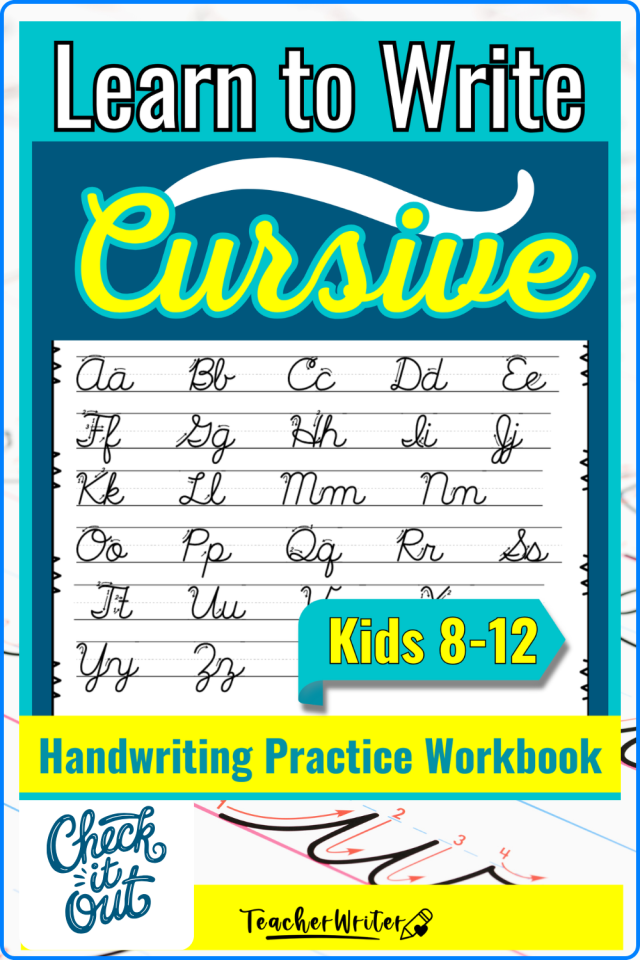
Learn more in this free sample of how I teach cursive or view the full book, Learn to Write Cursive : Kids Handwriting Practice Book, on Amazon. It’s also available as a digital download from the TeacherWriter Store on Teachers Pay Teachers.
“My favorite thing is that the lesson plans tell you which letters to start with. I am printing the uppercase and lowercase two per page and doing a letter a day. I also love how there are also figurative language tracing elements as well. Perfect curriculum for teaching cursive and so affordable. ” ~~~Michelle
You can find even more cursive handwriting books I’ve created for extra practice on Amazon. This image will take you to my author page where you can see all of the cursive books.

Try it out with a 28-page sample of these cursive handwriting workbooks.
In summary, the key points in this article include:
Handwriting remains one of the most powerful tools for learning. By slowing down and processing information through writing, students engage the brain more fully and retain what they learn longer. Whether in a traditional classroom, homeschool, or tutoring session, teaching students to take notes by hand—and even in cursive—can strengthen comprehension, recall, and overall academic success.
Handwriting remains one of the most powerful tools for learning. Taking notes by hand forces one to slow down and think about the concepts they’re learning. By processing the lesson through writing, students engage the brain more fully. Taking notes with paper and pencil or pen fires up the metacognition which is the hallmark of solid learning.