
Explore 4th grade California History and Social Studies resources for the four regions, 21 missions, the 1849 gold rush, and state government. Find how to make the reading accessible, use games for review, and find free companion tools.
Home » TeacherWriter.co Blog and News » Teaching Strategies »
Whether you’re teaching a class of thirty students or one curious kiddo at your kitchen table, you’ve probably seen the less than excited facial expression when the California History and Social Studies textbook comes out.
The vocabulary is dense. The passages run long. And to be honest, dry text can never compete with what these stories actually deserve: dramatic landscapes, diverse people, and events that shaped the Golden State we call home.
So how do we bridge that gap? How do we take the big units of 4th grade California History and turn them into something kids actually want to read and learn about?
I love California history, and I love teaching it. I spent years figuring out how to make it as interesting and engaging as possible. Believe me when I say I’ve tried many different things. I want to share the ideas and resources with you, unit by unit.
Starting With the Land: The Four Regions
Every good story needs a good setting, do you agree? We always begin the school year learning about the land itself. Understanding California’s geography and four regions, the Mountain Region, the Central Valley, the Coastal Region, and the Desert, lays the foundation for everything that comes after. Once kids understand where people lived, and why they came here, the rest of California’s history starts falling into place.
Maps and landform lists can go flat pretty fast, though, can’t they? That’s why I love turning this unit into something hands-on. A Collaborative Regions Poster gets everyone contributing to one big visual of the state, whether it’s a whole class, or a houseful of siblings. Suddenly geography isn’t a page they read; it’s a place they built together.
In California Regions and Landforms, I kept the reading passages at a genuine 4th-grade level, so kids can dig into the “why” of where people settled without getting lost in the vocabulary first. It’s a small shift, but it makes a big difference. When the text doesn’t fight them, curiosity gets a chance to lead.
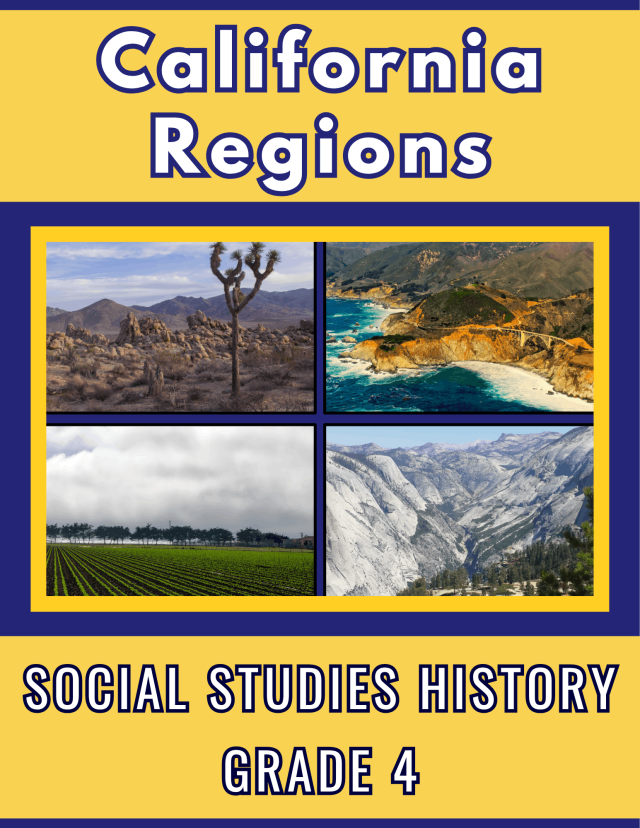
I also included a mini-model of the collaborative poster inside this book that your young learners can color and study.
On my Youtube channel, you’ll find some popular videos about the regions of California that are student facing, meaning they’re made especially for the kids.
Walking Through the Missions With Open Eyes
The Mission era might be the most iconic stretch of the 4th-grade curriculum. It’s also the trickiest, due to the amount of material to cover.
Gone are the make-a-mission-model days (though I still have salt-dough flashbacks from my son’s project). Today’s students deserve a fuller, more honest picture, one that holds space for both the Spanish and the California Native nations’ perspectives.
That’s a lot to ask a nine-year-old to process from a dense textbook chapter. It’s exactly why teaching California missions well can be so difficult. So instead of a standard report, I like to let kids become curators of their own understanding with an editable Mission Flipbook.
Each page in the flipbook gives them a structure to organize daily life, the land, and the people’s stories. They can use the informative passages about one mission of their choice to complete it. It makes a blank page feel a lot less intimidating and a lot more like their own work to be proud of.
You’ll can get a copy of the flipbook template free when you purchase the California Missions book. They’re also available in my Teachers Pay Teachers store where you can purchase one or all of them. They make terrific study aids before or after a visit to a mission. They also make a wonderful Open House artifact.

For more concrete ideas and resources to help you teach about the missions, this blog post is for you. Missions in California : Start Here to Write That Report!
You’ll also find a video with fun facts about the missions on my Youtube channel.
Panning for Vocabulary: The Gold Rush
Is there a more electric unit in all of California history than the Gold Rush? Probably not. It’s the perfect moment to lean hard into vocabulary-building and those irresistible “what would you have done?” conversations. You can also do a classroom conversion with Gold Rush era designs and artifacts.
The trick with any good Gold Rush activity is keeping all that gold fever excitement from burying the deeper understanding underneath it. In my California Gold Rush workbook, I built in wordsearches and crosswords and games with a twist. Once students correctly solve the puzzle, a secret word or phrase reveals itself. (By the way, I included these types of activities in all of the California History workbooks.)
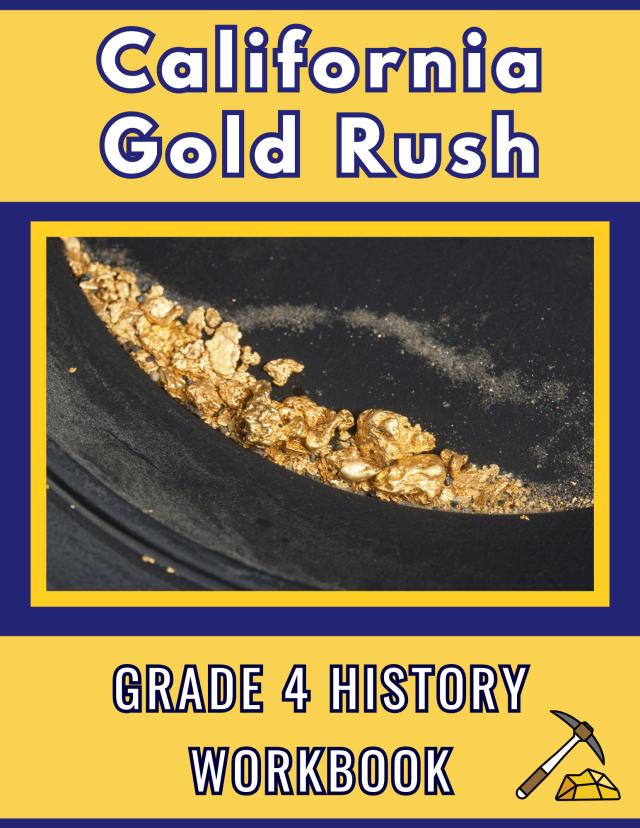
Suddenly students aren’t just hunting for vocabulary words; they’re solving a mystery. And when a passage about life during the Gold Rush doesn’t require a dictionary on every line, kids finally have the brain space to actually imagine life as a forty-niner.
My blog post, Strike Gold in the Classroom has plenty of ideas and resources for you to really pump up your instruction about this renowned era.
Cracking the Case: California Government
We usually save Government for last, because it’s definitely a challenge to get through the other CAHSS units before the end of the school year. Let me be honest with you. Convincing a 10-year-old that the legislative process is fascinating is no small feat.
The three branches, the rights and responsibilities of citizens, and how a bill becomes a law, are abstract concepts for a fourth grader. Especially after the excitement of learning about the Gold Rush, (did you get to take a field trip to Coloma?) how will you hold their attention?
When it comes to California government for kids, I’ve found the best approach is to turn it into a case to crack. Whenever we can make learning a game, the kids dive right into it. In the California Government workbook, kids become detectives, hunting back through the text for evidence to support each answer. Every correct answer reveals a highlighted letter, and once they’ve gathered them all, they unscramble a mystery word. A reading comprehension lesson quietly becomes an escape-room challenge and nobody even notices they’re practicing citing evidence.
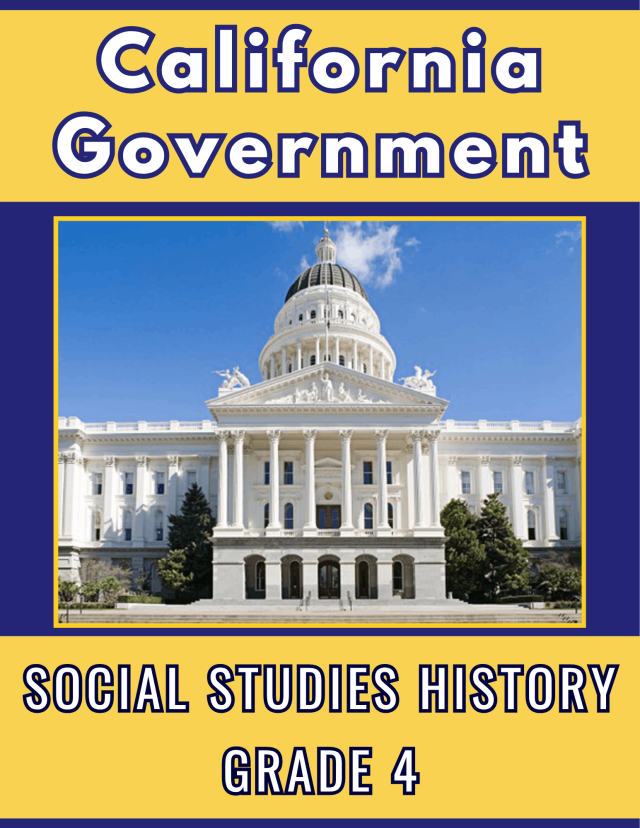
To close out the unit with a fun review, I’ve also created an Interactive PowerPoint Review Game for California Government. It’s free to download on my site when you purchase the printed workbook. If you prefer not to buy the workbook, you can purchase the game in my Teachers Pay Teachers store. It’s perfect for a classroom quiz-show afternoon or a family game night at home.
If you prefer the game with spoken audio support, you might want to consider the California Government Review Game in a Boom Deck with accessibility features.
A Softer Landing, Without Losing the Rigor
The Discover California History series grew out of a simple wish: that every teacher or homeschool parent like you, searching for engaging CAHSS resources, might have another option beyond a too-dense textbook. These workbooks can stand entirely on their own, or work as a companion to whatever curriculum you’re already using.
These workbooks and TPT resources don’t water anything down. They build a softer landing with text kids can actually read with confidence, paired with games and puzzles that make them want to turn the page. You an I both know that when history feels like an adventure instead of an assignment, the learning tends to stick?
If you’d like to explore the full series covering Regions and Landforms, Missions, Gold Rush, and Government, you can find it on Amazon.
Here’s to making this the best “California year” yet.
Cheers!
Additional blog posts about teaching California History: